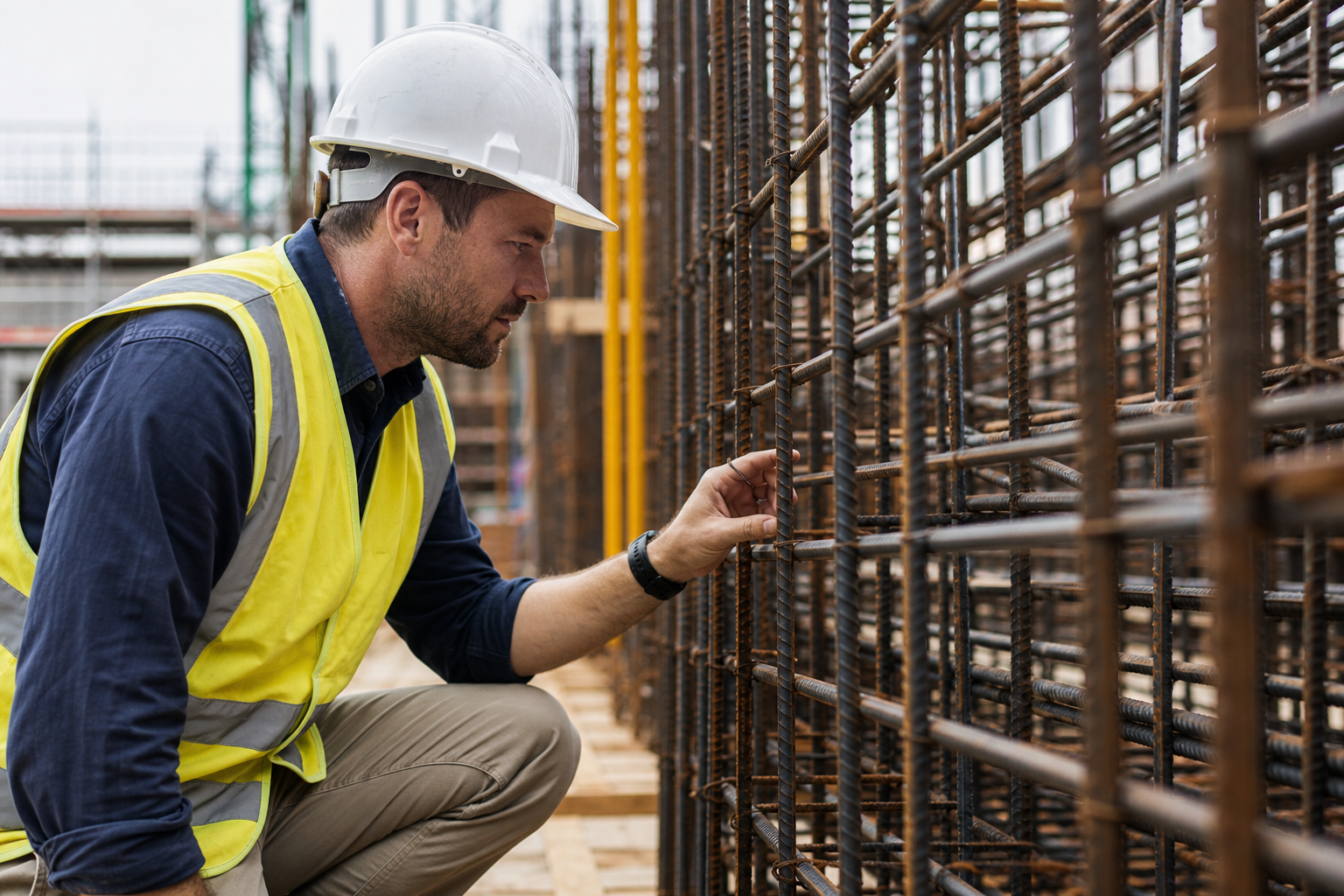
Quality and safety are foundational to steel fixing on active construction sites. Konstruct Steel Fixing PTY LTD operates under Work Health and Safety legislation, applicable Australian Standards for reinforcement and concrete construction, and the quality requirements of builders and head contractors who engage the company as a steel fixing subcontractor across South Australia.
Australian Standards and Technical Compliance
Reinforcement installation in Australia is governed by a framework of standards that define material properties, structural design rules, and construction practices. Konstruct Steel executes fixing work with primary reference to AS 3600 — Concrete structures — which establishes requirements for reinforcement detailing, cover, laps, and anchorage in concrete construction. Steel reinforcing materials are specified under AS/NZS 4671, and fixers verify that bar marks, diameters, and grades on site correspond to the schedules and certificates applicable to the project.
Project documentation may impose additional requirements through the structural engineer's specifications or principal certifier conditions. These may include tightened cover tolerances, specified chair types, or hold-point inspections before pour approval.
Compliance is demonstrated through correct installation observable at pre-pour inspection — bar spacing, lap length, cover depth, tie integrity, and conformance to the issued for construction drawings. Where non-conformances are identified, corrective action is completed before the reinforcement package is released for concrete placement. The company does not proceed with undocumented deviations from the approved design.
Work Health and Safety on Site
Konstruct Steel Fixing PTY LTD operates within the Work Health and Safety Act 2012 (SA) and associated regulations. On each project, the company aligns its activities with the principal contractor's WHS management plan, site-specific rules, and induction requirements. Safe Work Method Statements are prepared for steel fixing activities including manual handling of bar and mesh, work at height on formwork and slabs, use of tying tools, and interaction with cranes and other plant.
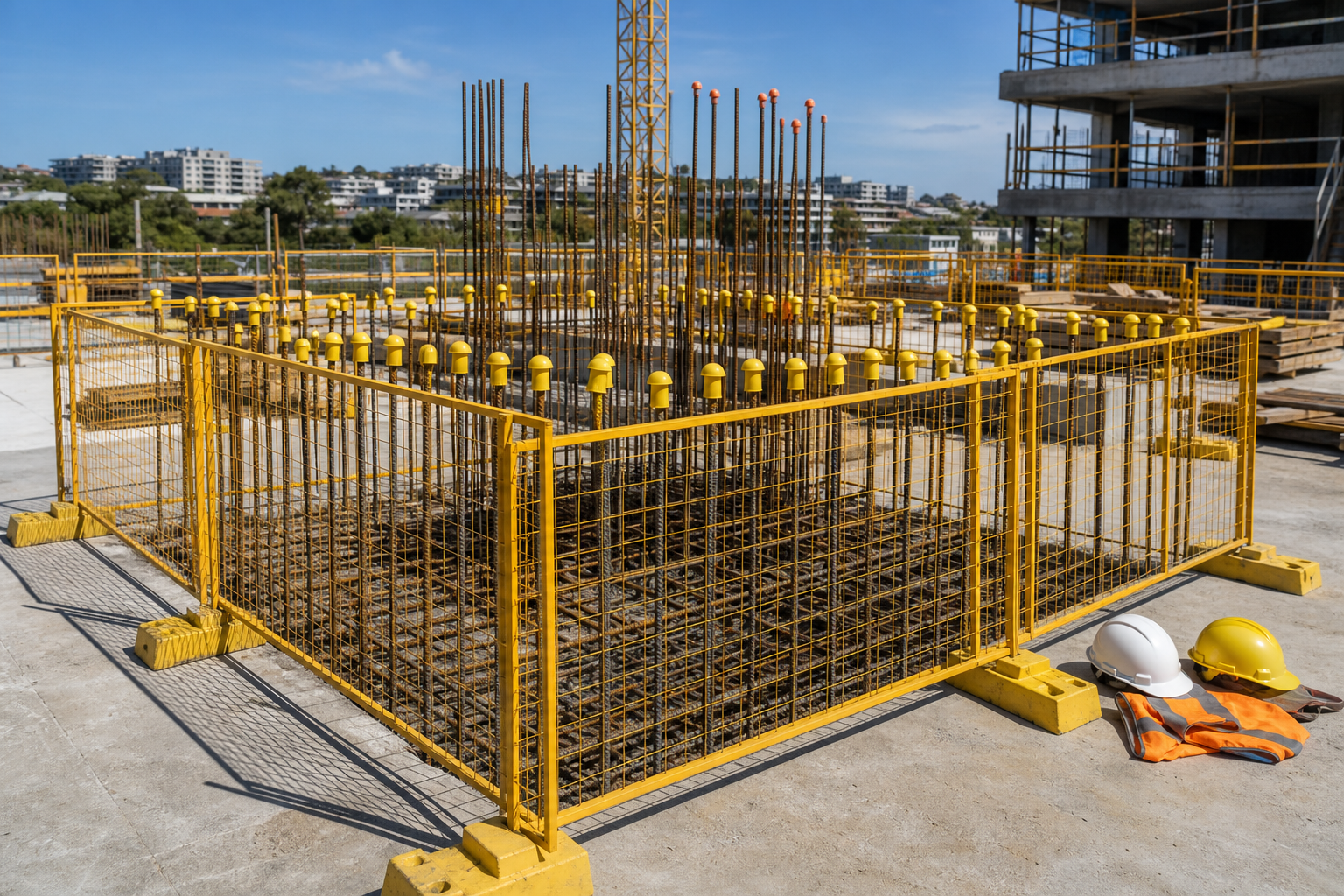
Hazard controls address struck-by and caught-between risks from moving plant, falls from elevated work areas, musculoskeletal injuries from lifting and carrying reinforcement, cuts and abrasions from bar ends and tie wire, and eye injuries from tying operations. Personal protective equipment — including steel-capped boots, high-visibility clothing, gloves, eye protection, and hard hats — is mandatory on all sites. Where work occurs at height, harness and lanyard systems are used in accordance with the project fall prevention plan and anchor point provisions supplied by the head contractor.
Toolbox talks and pre-start briefings address daily task hazards, changes to site conditions, and coordination with adjacent trades. Incidents, near misses, and hazards are reported through the principal contractor's reporting channels. Konstruct Steel supports stop-work authority where unsafe conditions are identified and will not compromise safety to meet programme pressure.

Principal Contractor Coordination. As a subcontractor, Konstruct Steel operates under the WHS duty-of-care framework established by the head contractor. Induction, access permits, crane lift plans, and exclusion zones during concrete pours and heavy lifts are observed without exception. Safety documentation is maintained and presented for audit when requested.
Pre-Pour Inspection
Pre-pour inspection is the critical quality gate at which installed reinforcement is verified before concrete is placed. Konstruct Steel understands that once concrete is poured, correction of reinforcement errors is costly, disruptive, and in many cases impractical. Accordingly, fixing crews aim to complete work that will pass first inspection against the structural engineer's requirements and the principal contractor's quality checklist.
Inspection scope typically includes verification of bar and mesh type, diameter, grade, spacing, and layout against the reinforcement drawings and schedules. Lap lengths at splices, cover depth, and tie quality are checked before pour approval.
Konstruct Steel coordinates with site management to schedule inspection at a practical time before the concrete order is confirmed. Where inspection identifies items requiring rectification, crews remain available to complete corrections within the programme window.
Cover, Chairs, and Lap Splices
Concrete cover protects reinforcement from corrosion and provides fire resistance performance as designed. Achieving nominal cover is a primary quality objective on every package. Konstruct Steel installs chairs, spacers, and bar supports at spacing and heights consistent with the project specification — commonly referencing AS 3600 default cover for the relevant exposure classification and element type, unless the engineer specifies otherwise.
Plastic chairs, steel bar chairs, and continuous support systems are selected based on cover depth, bar weight, and substrate conditions. In suspended slabs, bottom reinforcement is supported to maintain cover to the soffit; top mat chairs or bar spacers separate top and bottom layers where double-mat construction applies. Edge bars and horizontal bar in walls and columns receive spacers to maintain cover to formed faces. On ground slabs, mesh and bar may be chaired from compacted base or supported on proprietary systems compatible with the slab thickness and load during concrete placement.
Lap splices transfer force between adjacent bar lengths where continuity is required. Lap length is determined by bar diameter, grade, concrete strength, and whether the lap is in tension or compression — as detailed by the structural engineer or calculated in accordance with AS 3600. Konstruct Steel installs laps at the lengths shown on the drawings, with bars positioned so that the specified overlap is achieved and bars are tied to maintain alignment during pour. Staggered lap arrangements in slabs and walls are observed where the design requires laps to be offset between adjacent bars.
Site Coordination and Quality Communication
Steel fixing does not occur in isolation. Effective site coordination ensures that reinforcement is installed at the correct time relative to formwork completion, services rough-in, waterproofing, and inspection availability. Konstruct Steel participates in coordination meetings and maintains communication with site supervisors, formwork contractors, and concrete suppliers regarding pour dates, bunkering locations, and any last-minute drawing revisions.
Drawing changes issued during construction are assessed for impact on fixed or partially fixed reinforcement. When revisions affect completed work, the company seeks written confirmation of the required remedial scope before proceeding. RFIs raised during fixing are tracked until resolved so that ambiguous details do not reach pre-pour inspection unresolved.
Material deliveries of bar and mesh are coordinated to minimise double handling and on-site storage congestion. Waste wire, offcuts, and packaging are managed in accordance with site waste procedures.
Quality outcomes depend on skilled fixers, clear documentation, and a site culture that treats pre-pour inspection as a shared responsibility between the steel fixing subcontractor and the principal contractor. Konstruct Steel Fixing PTY LTD commits to this standard on every South Australian project it undertakes.
Continuous Improvement
Lessons from site audits, inspection feedback, and incident reporting inform ongoing refinement of SWMS content and fixing techniques. Enquiries regarding quality and safety procedures can be directed through the contact details published on this website.
Near-miss reporting on reinforcement handling, manual handling of bar bundles, and edge protection at elevated decks is encouraged without blame attribution — the objective is preventing injury, not paperwork for its own sake. When engineers or certifiers identify recurring defect themes on a project, we review those themes in crew briefings so corrective action is systematic rather than individual. Safety and quality share the same root cause on steel fixing sites: rushed work in unclear conditions. Our management response to both is clearer lookahead, written instructions on revisions, and stop-work authority for foremen when compliance cannot be achieved within the stated window.