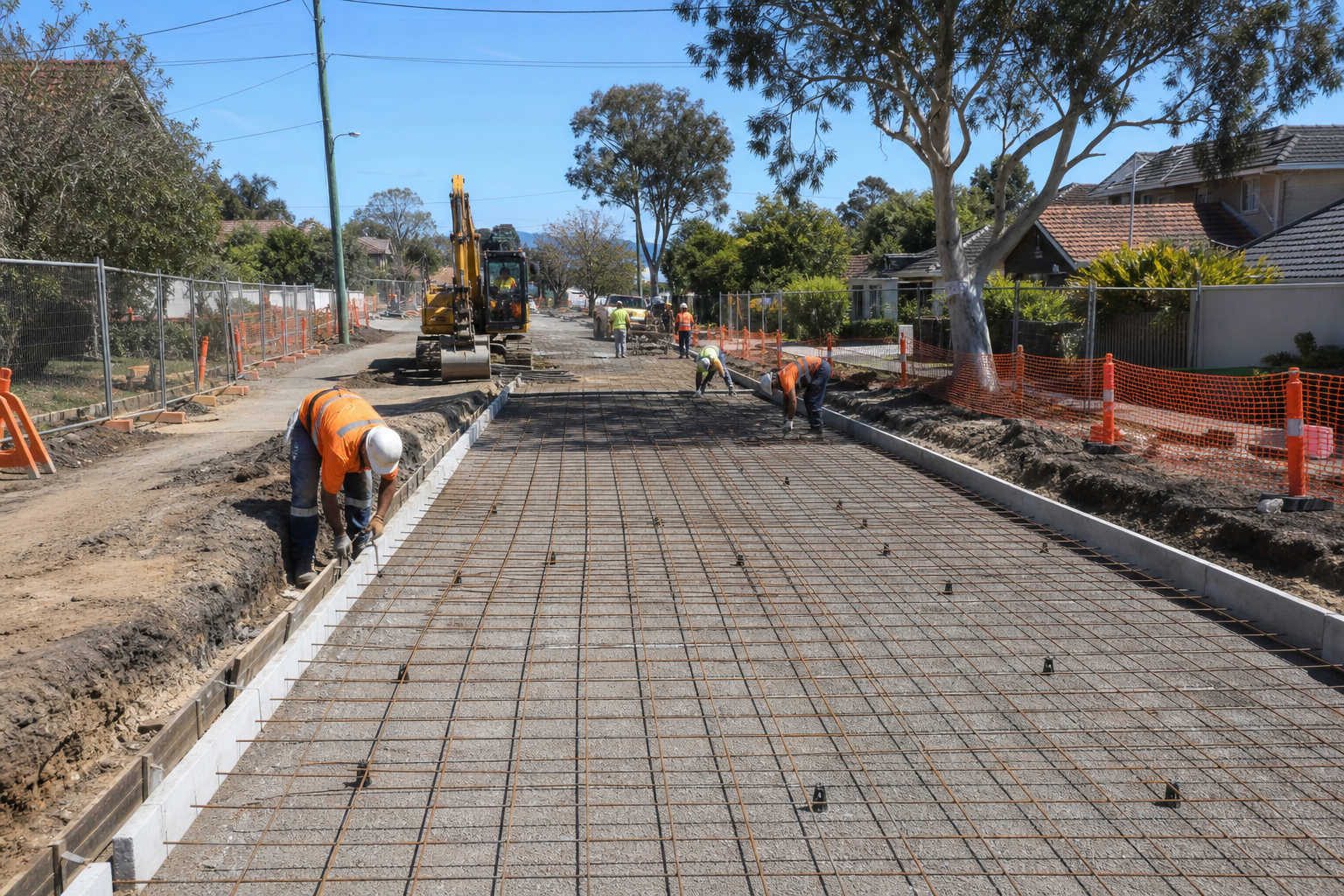
Konstruct Steel Fixing PTY LTD supplied reinforcement installation for a council road reconstruction project in Salisbury — delivering kerb, pavement and culvert steel within a staged traffic corridor programme managed under City of Salisbury engineering requirements.
Project Overview
The road reconstruction involved renewal of pavement structures, kerb and channel elements, and associated culvert reinforcement across multiple stages along the corridor. Our scope covered bar and mesh installation within pavement layers, tied reinforcement in kerb and footpath zones, and main bar work within culvert structures. All steel fixing was completed to council-issued drawings and the head contractor's reinforcement schedules, with inspection at defined hold points before concrete placement in each stage.
Challenges
Council road works demand reinforcement completion within compressed stage windows governed by traffic management plans and resident access requirements. Laydown areas were limited to designated zones within the corridor, requiring efficient material handling and tidy staging of mesh sheets and bar bundles. Pavement reinforcement had to maintain cover above subgrade while accommodating services crossings and survey set-out changes. Culvert zones required precise tying of face bars and links within formwork or against existing structures, often with restricted access from one side of the excavation.
Solutions
We aligned crew mobilisation with each construction stage, completing reinforcement in the active zone before the stage handover to concrete crews. Mesh was laid with correct overlap and chairs to maintain cover, with edge bars tied at kerb interfaces. Culvert reinforcement was assembled in sections where access allowed, then positioned and tied to schedule with engineer verification at hold points. Daily coordination with the civil foreman ensured steel fixing kept pace with excavation, formwork and pour bookings — avoiding the programme delays that arise when reinforcement is incomplete at stage close-out.
Technical Scope Detail
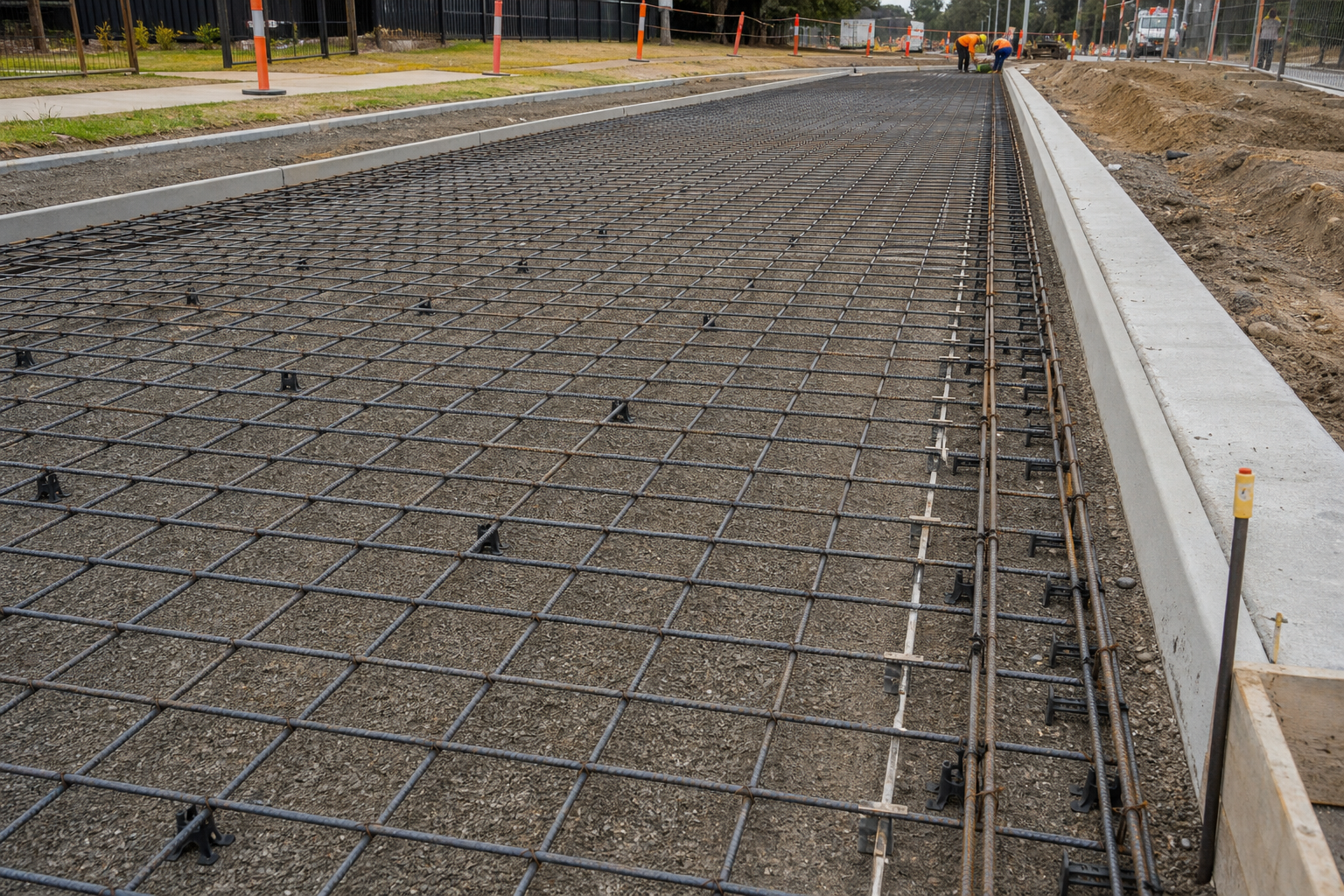
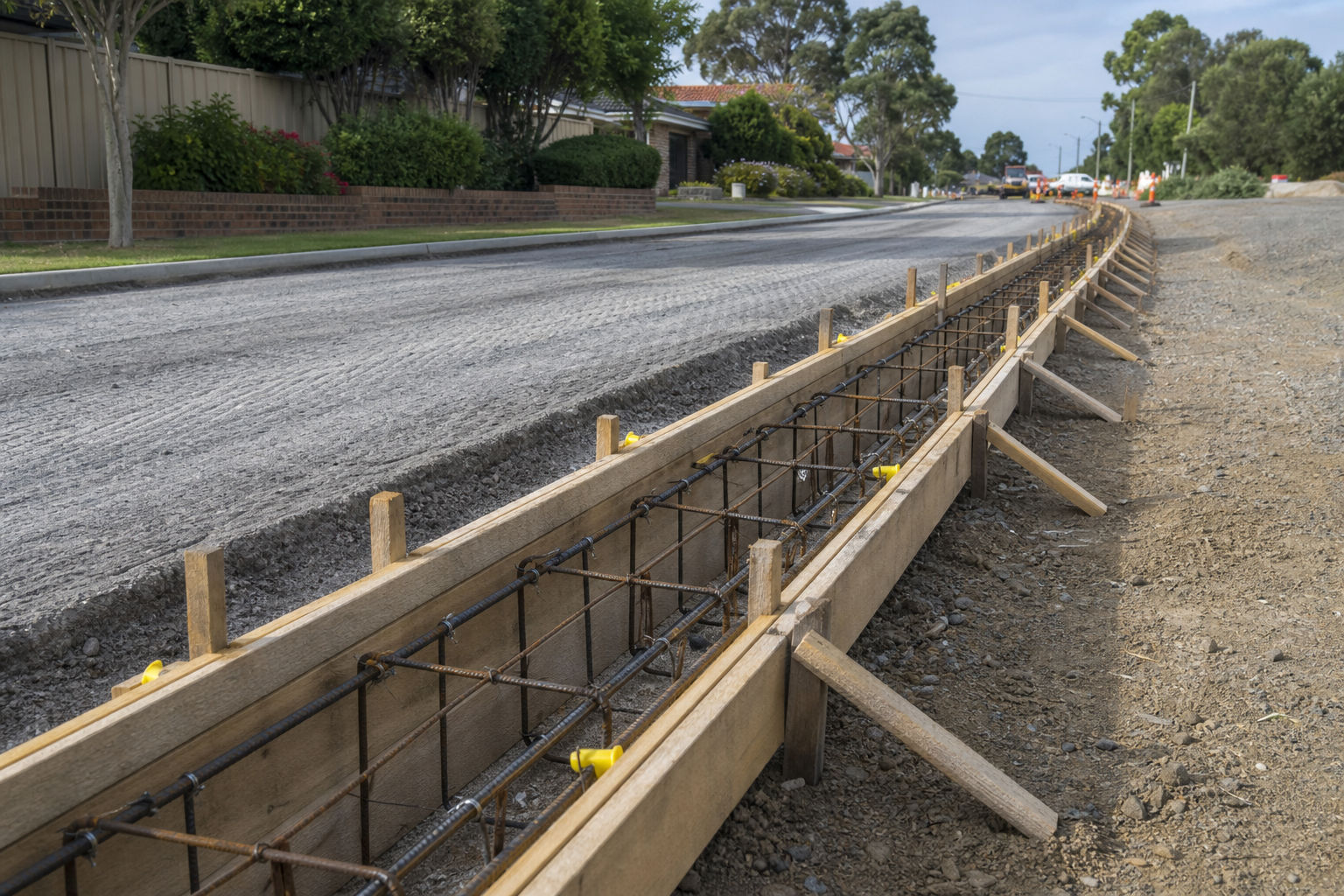
Pavement layers incorporated mesh and bar combinations per council standard drawings — mesh in base slabs with supplementary N12 edge bars at joints and thickenings. Kerb and channel reinforcement followed City of Salisbury detail schedules, with face bars tied against formwork profiles and links at spacing marked from chainage reference points. Culvert structures combined straight bars, ligatures and mesh on irregular geometries, set out from survey pegs and structure centre lines to maintain cover in aggressive exposure zones below pavement level.
Construction joints across staged pours required dowel and continuity bar placement to council specification, with bar chairs selected for stability on prepared subgrade — not ad hoc blocking that fails inspection when blinding is uneven. Lap lengths at mesh sheets were measured and marked before adjacent stages tied in, preventing the cumulative spacing drift that occurs on long kerb runs when laps are assumed rather than verified.
Quality Assurance & Inspection
Council inspectors focused on cover to exposure zones, dowel alignment at joints, and compliance with standard drawings where project-specific deviations had not been formally approved. We prepared photo logs with chainage references on request, aligned with the project's inspection and test plan. Hold-point inspections were booked inside traffic management possession windows — we would not sign off a zone without confirmed inspection availability before concrete was ordered.
Weather exposure on open corridor excavations created intermittent ground condition challenges. Where blinding was inadequate or water accumulated in trenches, we escalated before chairing mesh — reinforcement cannot achieve compliant cover on unstable subgrade, and pouring against failed inspection is costlier than a disciplined stop-and-fix decision.
Coordination With the Principal Contractor
Staged road reconstruction demands steel fixing that matches earthworks and formwork readiness chainage by chainage. Our foreman attended weekly civil coordination meetings, aligning crew mobilisation with the superintendent's stage release plan. Traffic management plan changes — lane closures brought forward or delayed — were communicated same-day so fixing crews were not standing idle in a closed corridor or, worse, incomplete when a pour possession started.
Outcomes
Reinforcement across all staged zones was fixed to council specification and passed inspection ahead of concrete placement. The road reconstruction programme maintained momentum through consistent steel fixing delivery within the traffic corridor. Kerb, pavement and culvert elements received durable reinforcement suited to council exposure and loading requirements — supporting long-term performance of the reconstructed road infrastructure in the Salisbury area.
Key Outcome
Council road reconstruction reinforcement completed across all programme stages — kerb, pavement and culvert steel fixed to specification within live traffic corridor constraints and inspection-ready ahead of each concrete pour.