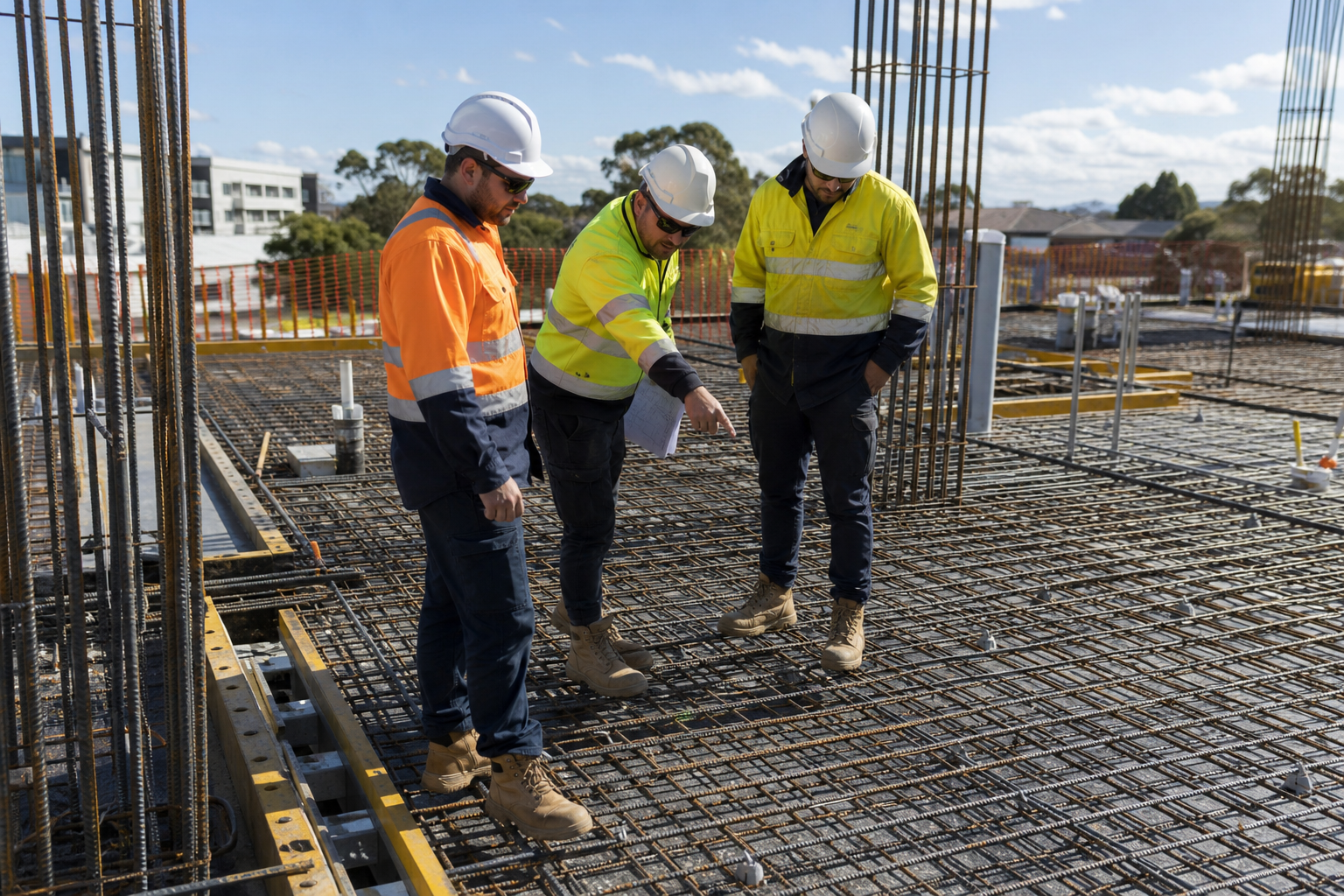
"Steel complete" and "pour ready" are not the same statement. Konstruct Steel Fixing PTY LTD uses a structured pre-pour handover checklist on every package — residential slab, commercial deck, or civil structure — because the cost of discovering a defect when the pump is onsite is borne by everyone on the programme.
Our checklist evolves with project complexity, but the logic is constant: verify reinforcement against the current drawing, confirm support and cover, close out laps and ties, brace where required, clean the zone, and communicate status clearly to the builder and engineer. This article sets out what we actually check — not a generic quality slogan — so project teams know what to expect before concrete is ordered.
Drawing and revision control
Every handover starts with revision confirmation. The foreman holds the current structural reinforcement drawing and any applicable details, RFI responses and marked-up changes. We walk the zone grid by grid — or chainage by chainage on civil work — comparing bar sizes, spacing, lap lengths, chair types and special details to the issued documents. If a detail is missing or contradictory, we stop and escalate. We do not interpret engineering intent without written approval.
On South Australian projects, it is common to have architecturally driven set-downs and step-offs that affect reinforcement levels. We verify levels against survey or formwork marks before calling the zone complete. A slab that is steel-complete at the wrong level is worse than incomplete steel.
Mechanical completion items
Bar spacing is checked at representative bays and at every congested node. Lap lengths are measured at mesh and bar joints. Tie wire is complete — not merely at visible faces. Chairs and spacers are intact after other trades. Bar chairs supporting top mat are not deformed. Starters and dowels are plumb or to specified batter, capped where required for safety.
Bracing and alignment matter on tall walls and stair cores. We confirm temporary bracing remains until pour as specified. Loose bar ends are bent or capped per site rules. The zone is free of debris, tie wire offcuts and tripping hazards that affect concrete placement quality.

Cover verification
Cover is spot-checked with gauges at locations defined by our internal standard: minimum three random grid points per pour zone plus all congested nodes and every construction joint. Results are within project tolerance or the zone is not handed over. Where engineers specify cover boxes or continuous spacers, we verify those systems are installed per detail.
Penetrations and embedments
Slab boxes, conduit sleeves, anchor bolts and pour strips interact with reinforcement. We confirm steel is fitted around embedments without violating cover or lap requirements. If an embedment was added after steel fixing commenced, we review the impacted area under the revised detail before handover.
Konstruct position: Handover status is reported as Ready for Inspection, Inspection Cleared, or Hold — with specific hold items listed. Ambiguous "she'll be right" handovers are not part of our process.
Inspection coordination
We request engineer inspection when our internal checklist is complete. We attend the walk with the foreman who fixed the zone so questions are answered immediately. Minor items are corrected on the spot where possible. Hold items are prioritised and re-inspection booked before concrete is confirmed.
On fast-track Adelaide residential programmes, builders sometimes book concrete optimistically. We communicate checklist status daily on multi-zone pours so site management can see which bays are genuinely on track. Transparency prevents Saturday morning arguments at the slab edge.
Documentation
Where the project quality plan requires reinforcement records, we supply lap registers, photographs of congested nodes, and signed handover sheets. Civil and infrastructure projects increasingly expect digital photo logs with metadata — we accommodate reasonable project systems without delaying the physical work.
Residential, commercial and civil — different handover pressures
Residential slab packages often move quickly with multiple pours per week across lots or levels. Our checklist is compressed into zone-based sign-off — garage slabs, typical floors, roof slabs — with consistent cover and lap rules applied at speed without skipping verification. Commercial decks carry heavier inspection regimes and congested nodes at cores and transfer zones; we allocate senior foreman time to those walks. Civil structures add exposure classification and authority hold points — handover includes chainage references and alignment with the project's ITP milestones.
The checklist items are the same in principle; the emphasis shifts with risk. A missed mesh lap on a house slab is serious. On a transfer beam in the CBD, it is programme-stopping. We calibrate inspection thoroughness to consequence, not to convenience.
What this means for your project
If you engage Konstruct for steel fixing in South Australia, this checklist is embedded in our delivery — not offered as an optional extra. Builders who align concrete booking with our handover milestones experience fewer pour aborts. Engineers who walk zones that were checked to a consistent standard spend less time on defect lists and more on systemic issues worth their attention.
Pre-pour readiness is the last gate before concrete becomes permanent. We take that gate seriously.