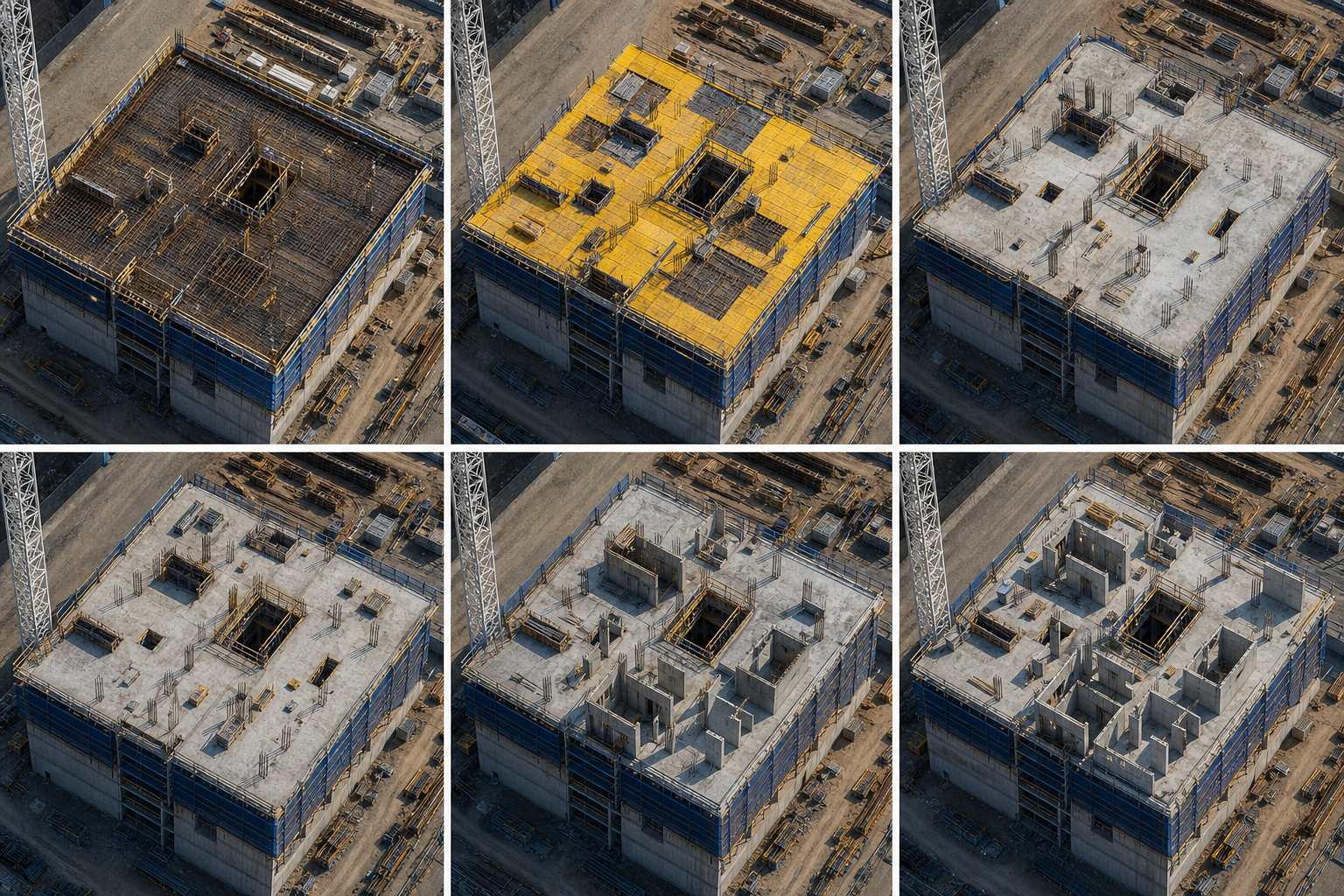
On Adelaide's multi-storey residential and commercial towers, the tower crane sets the heartbeat of the site. Steel fixing does not operate on its own calendar — it must lock into crane cycles, formwork strip times, inspection windows and concrete pour sequences or the level simply does not close.
Konstruct Steel Fixing PTY LTD has delivered reinforcement packages on high-rise and mid-rise structures across metropolitan Adelaide — from student accommodation and apartment towers near the CBD to commercial cores in suburban activity centres. The technical work of bar tying and chairing is familiar on every job. What differentiates successful high-rise fixing is coordination: knowing when steel can be flown, when the deck is safe to populate, when the engineer will walk the level, and how much labour can productively work in a half-open cycle without creating congestion or safety exposure.
Understanding the cycle, not just the level
A common programme shows "Level 12 — steel fixing" as a five-day bar. That line item hides the real dependencies. Formwork must be stripped or partially released on the level below to allow vertical bar continuity and jump-form ties. The crane may be shared with precast panel installation on one face while mesh bundles are needed on the other. Concrete pour on Level 11 may block access to the core for half a shift. Traffic management on the street affects delivery windows for long bars that cannot be double-handled without a crane pick.
We map the cycle before labour hits the deck. Our foreman attends the weekly programme meeting with the builder and reviews the lookahead for crane availability, concrete pour dates, formwork turnover and RFI closures that affect reinforcement. If the crane is booked for precast all Thursday morning, we do not schedule mesh drops for Thursday morning. If inspection is Friday 2:00 pm and pour is Monday 6:00 am, our completion target is Thursday close of business — not Friday lunch.
Vertical logistics and laydown
High-rise sites in Adelaide rarely have generous ground laydown. Steel arrives on semis, is offloaded under crane hook, and often goes directly to the working level or to a intermediate staging deck. We coordinate delivery times with the steel supplier and the builder's logistics manager to avoid trucks queueing on Magill Road-style suburban frontages or CBD laneways with strict time windows.
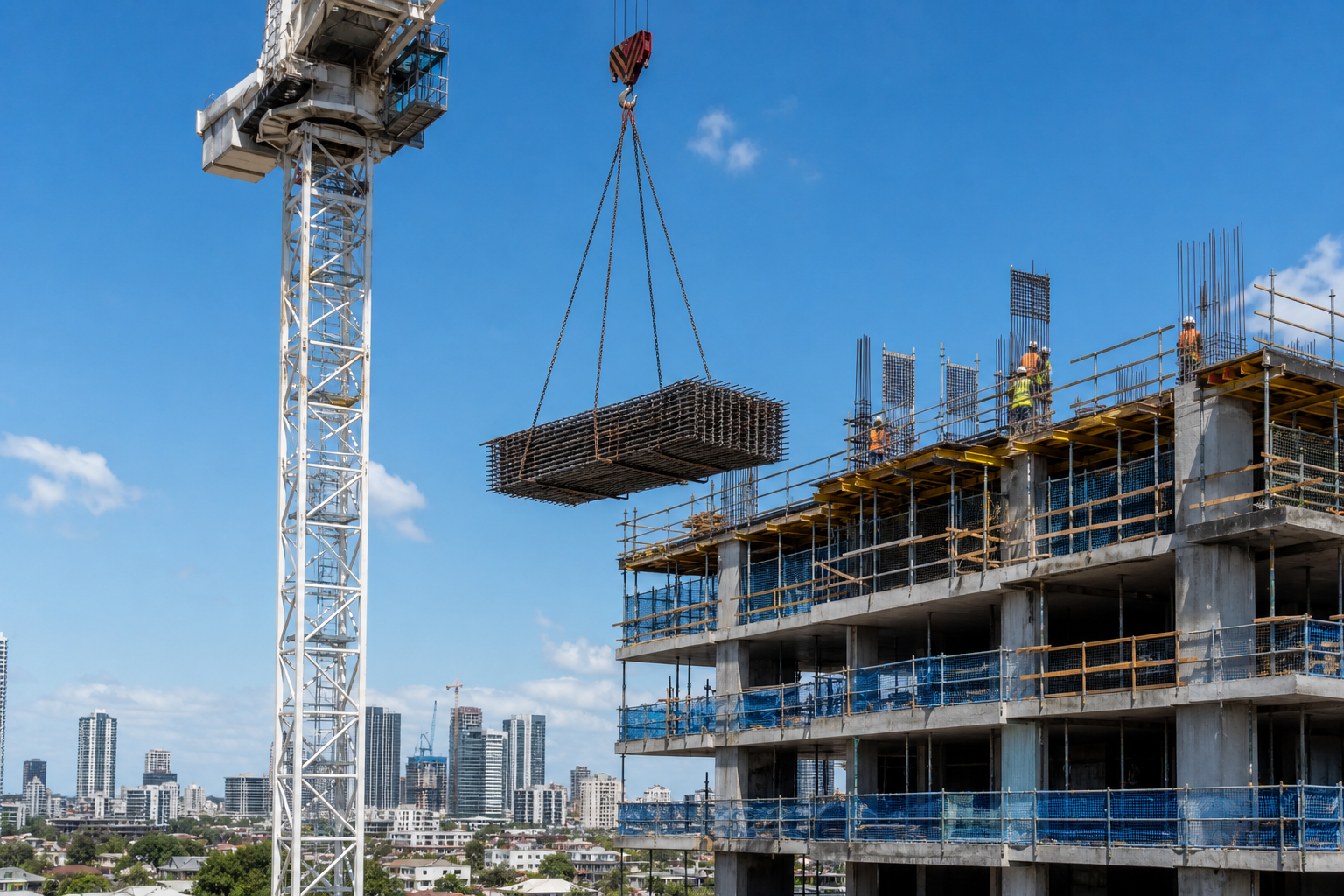
Bundle weights matter. We break orders into crane-liftable packages aligned with the tower crane chart at the required radius. Oversized bundles look efficient in the yard but cost cycles on site when the crane cannot lift them to the deck without re-rigging. Our estimators and foremen think in picks, not just tonnes.
Labour sequencing on an active level
Steel fixing labour on a tower level competes for space with formwork strippers, electricians roughing in slab boxes, and surveyors marking set-downs. We sequence our crew through the level in zones: typically core and shear walls first where vertical continuity governs, then main slab field, then edges and infill where detail is heaviest. That sequence is not universal — some programmes pour the core separately — but it must be agreed, not improvised.
South Australian WHS requirements and site-specific safety rules drive tethering, edge protection and crane zone exclusion. We brief crews at the start of each cycle on crane movements and exclusion zones. Productivity on towers is as much about uninterrupted work windows as it is about tying speed. A crew that sets up three times because crane picks were not coordinated will miss the inspection window even if individual fixers are experienced.
Inspection and pour alignment
Engineer inspection on high-rise often focuses on support, cover, lap lengths, bar spacing at congested nodes, and compliance with revised details issued after site measure. We request inspection slots when the level is complete — not when it is "mostly done." Partial inspection breeds partial sign-off and pour-day surprises. Our handover checklist (see our separate insight on pre-pour readiness) is designed to make inspection a confirmation exercise, not a defect hunt.
When inspection identifies items, we prioritise by pour criticality. Minor tie wire neatness is not equivalent to a short lap at a transfer beam. We communicate status to the builder in plain language: cleared, cleared with minor items, or hold. That transparency helps site management make informed decisions about concrete booking.
Konstruct position: We will not commit to a level completion date without reviewing crane and inspection windows. Accepting a date we cannot meet helps nobody — it erodes trust and forces unsafe rushing. We prefer honest lookahead over optimistic promises.
Drawing changes mid-cycle
Tower projects generate RFIs. Set-down depths change, slab thickenings move, and penetration clusters shift when services coordination lands late. We maintain a revision log on site and stop work in affected zones when a superseded detail is identified. Continuing with old details to "stay on programme" is how rework doubles programme loss. Our foremen are empowered to pause — with immediate notification to the builder — when a revision creates a conflict with steel already placed.
Where post-tensioning or transfer structures are involved, we allow additional coordination time in the cycle. Adelaide engineers are rightly conservative on these elements. We align with the PT contractor's profile requirements before stressing is even discussed.
What builders should expect from a high-rise fixer
Engage steel fixing early in the cycle planning, not after formwork is booked. Provide crane forecasts and inspection lead times. Share drawing revisions the same day they issue. If you want a level ready for Monday pour, tell us what "ready" means on your project — inspection cleared, or merely steel complete pending inspection.
Konstruct delivers high-rise steel fixing as a coordinated trade, not a body-hire function. The reinforcement on the deck is our craft; fitting it into the crane cycle is our responsibility when we have the information to do so. Across South Australia's growing stock of medium and high-rise housing, that coordination is as valuable as the tying itself.
Medium-rise residential growth in Adelaide
Adelaide's infill and medium-density corridors — Norwood, Magill, inner northern and western growth areas — are producing six- to twelve-storey residential stock with fixing cycles shorter than CBD commercial towers but sharing the same crane dependency. Builders sometimes underestimate mobilisation and inspection lead times on these projects because they are "not a high-rise." Our experience on multi-level residential packages shows the opposite: cycle discipline matters from level three upward, and starter bar continuity across pours is where programme slips begin if fixing is treated as a commodity trade.