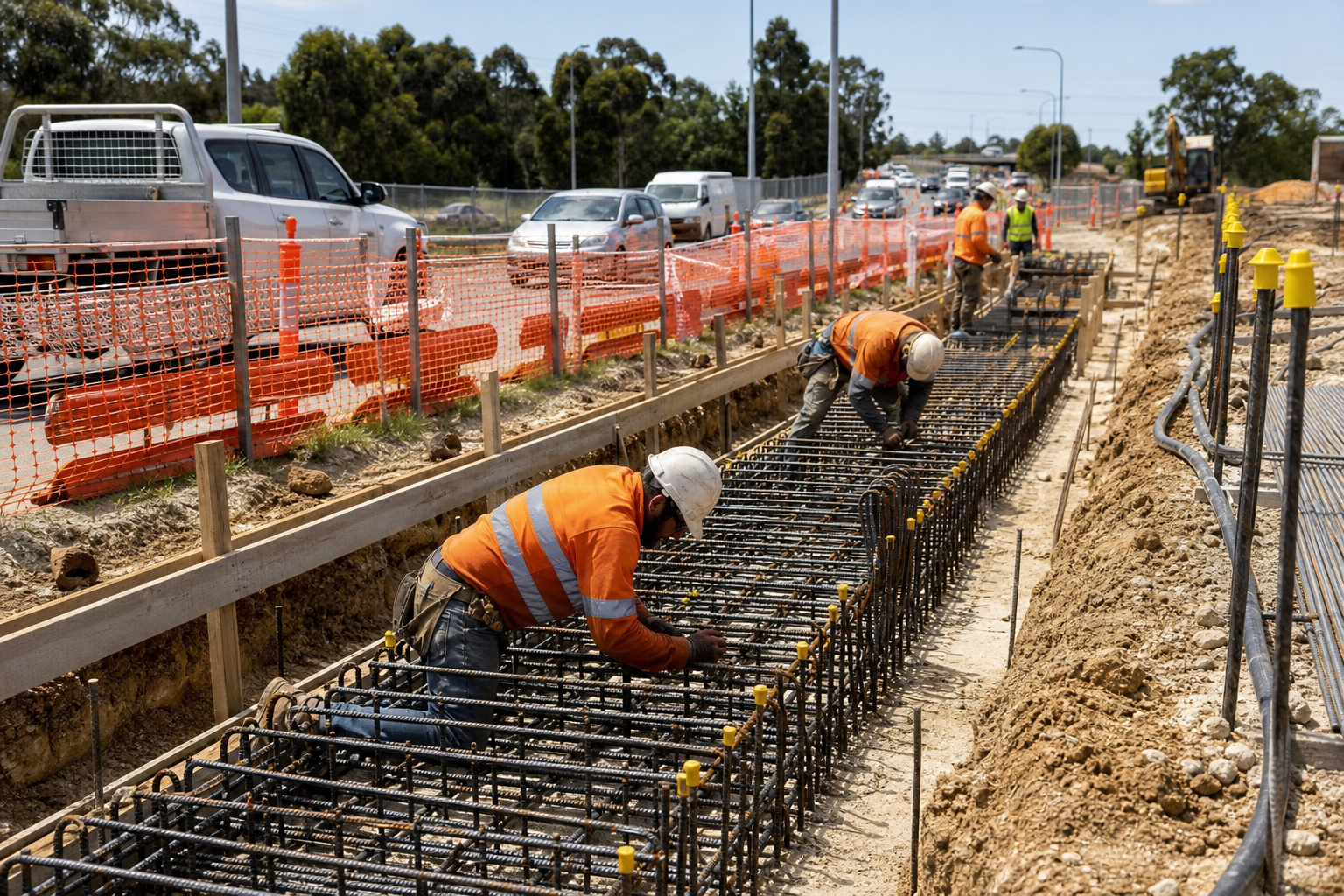
Civil steel fixing in active road corridors is a different trade environment to a greenfield building site. Traffic is moving, work windows shift, inspections involve council representatives, and the reinforcement must be right the first time because second chances are expensive and politically visible.
Konstruct Steel Fixing PTY LTD undertakes reinforcement packages for civil infrastructure and council road projects across South Australia — kerb and gutter structures, culverts and headwalls, bridge approach slabs, pit structures, footpath thickenings and associated drainage concrete. These jobs share building-site fundamentals: correct bar, lap, cover and tie. They add corridor constraints: Traffic Management Plans, night works, lane rental, exposure to public scrutiny, and coordination with earthworks, stormwater and asphalt crews who cannot wait indefinitely for steel.
Programme reality on live corridors
Council and DIT-managed projects publish possession windows — sometimes only overnight Friday to Monday, sometimes staged lane closures across multiple weeks. Steel fixing must fit inside the window with allowance for engineer inspection, weather, and the concrete pour that follows. We review the TMP and the lookahead before mobilising. If the window assumes steel complete by 2:00 am Saturday but delivery is scheduled for Friday afternoon, the programme is already broken.
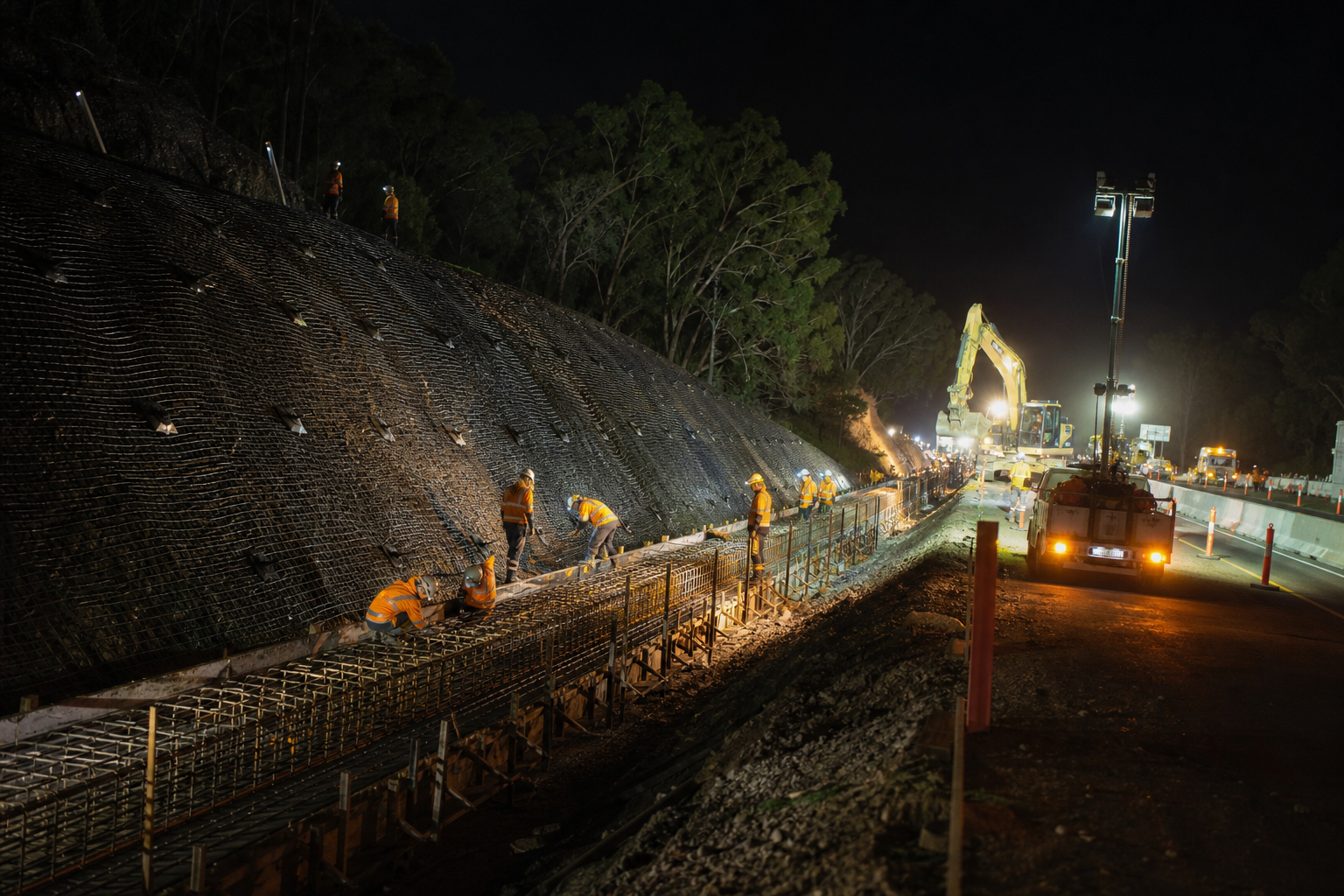
Adelaide's arterial roads and Hills-facing routes introduce additional complexity: steep grades affect delivery unloading, winter rain saturates trenches, and summer heat pushes concrete pours to night hours when lighting and traffic control must support safe fixing. We have worked corridors from the northern connector roads to Fleurieu town main streets — each with different council inspection habits and documentation expectations.
Safety and public interface
Active corridor work demands current site inductions, traffic controller coordination, and clear separation between public and work zones. Our crews work within the approved TMP — no informal lane intrusions to access a trench. Tethering, edge protection at open excavations, and crane or plant exclusion zones are non-negotiable. Civil steel fixing incidents attract regulatory attention beyond the project; we operate accordingly.
Steel deliveries in corridors are timed to minimise storage on road shoulders. Bundles are placed in the work zone under traffic control, not on footpaths or driveways. We coordinate with the head contractor's traffic supervisor before each shift.
Structures typical to SA civil packages
Culvert and pit reinforcement often combines straight bars, ligatures and mesh on irregular geometries. We set out from survey pegs and structure centre lines — civil tolerances are tight where precast lids or grates must fit. Kerb and gutter steel is repetitive but unforgiving of spacing drift over long runs; we use spacing marks and periodic checks against chainage.
Bridge approach slabs and transition zones integrate with pavement layers designed for heavy vehicle loading. Bar congestion at abutments requires early review of the detail before the pour window is locked. We participate in pre-pour meetings with the civil superintendent and request hold points where details are ambiguous.
Inspection and council hold points
Council and authority inspectors often focus on cover to aggressive exposure zones, dowel and continuity across construction joints, and compliance with standard drawings where project-specific deviations were not approved. Documentation matters: some authorities request photographs of reinforcement before pour with chainage references. We prepare photo logs on request and maintain alignment with the project's ITP.
Konstruct position: We will not pour-zone sign off in a corridor without confirming inspection availability inside the possession window. Booking concrete without confirmed steel inspection is how weekend closures fail publicly.
Weather and ground conditions
Open trenches take water. Chairs sink into mud. Cover to bottom reinforcement fails when blinding is inadequate. We stop and escalate ground condition issues rather than chairing mesh on unstable subgrade. Dewatering is the earthworks contractor's scope, but steel cannot be compliant in standing water — inspection will hold and rightly so.
Night works and possession windows
Many SA council packages specify night or weekend possessions for concrete placement to minimise traffic disruption. Steel fixing must be complete before possession starts — not "mostly done" with top bars to tie under torchlight. We plan backward from possession end time, allowing inspection inside the window and buffer for hold-item correction. Night fixing for steel is avoided where possible; when unavoidable, lighting, traffic management and WHS controls are confirmed with the principal contractor before mobilisation.
Deliveries of mesh and bar into active corridors are staged during permitted lane closure hours. We do not leave materials in travel lanes outside approved TMP conditions. That discipline protects public safety and protects the builder from authority stop-work events that make news for the wrong reasons.
Engaging a civil steel fixing crew
Builders and civil head contractors should confirm fixing crew experience on live traffic sites, not only building towers. Ask about night work capability, TMP compliance record, and how steel deliveries are staged when lane closure hours are tight. Konstruct mobilises civil packages with the same quality standards as our building work, adapted to corridor logistics.
Steel fixing in active road corridors is where programme discipline and public safety meet structural compliance. Done well, the public drives over a structure they never noticed under construction. Done poorly, the news story writes itself. We intend to stay invisible for the right reasons.